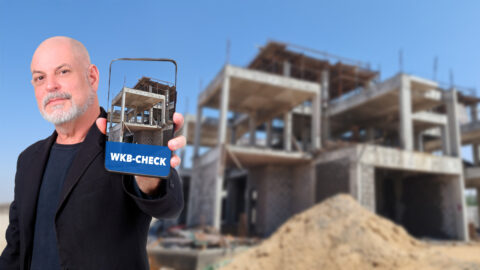
Because of digitization, the use of 3D models is increasing enormously; after all, they are the information carriers of projects. In his contribution "Quality assurance starts with model checking!" Bart Bol of Solibri talks about the importance of model checking and the role of software in this.
“During the engineering phase of a project, project planners and BIM coordinators often perform multiple model checks to ensure that everything fits and that the correct components are ordered,” says Bart Bol, Customer Success Manager at Solibri. “But architects and suppliers also use our software.”
Bol advises and supports customers in the Benelux region on how to integrate Solibri products into their business processes and helps them use the software to monitor the quality of their project information themselves.
Model Checking
Digitization in construction and infrastructure is a broad field encompassing various aspects. Solibri focuses on working with BIM models and performing model checks. “The construction industry is lagging behind a bit when compared to the aviation or automotive sectors,” says Bol. “In those industries, 3D models have been used for decades. In construction, it’s only relatively recently that the proverbial box of drawings, calculations, and all sorts of other information from all parties involved—and so on—has been consolidated into a single digital file. In 3D models, different components are still developed by different parties, but software ensures that all input is collected, combined, and verified. That last part—model verification—is crucial. A 3D model is a massive source of data. Each component is associated with information: about materials, dimensions, properties, etc. The more you want to make use of the information in a model, the more important it is to be certain that that information is accurate.’
Rule Sets
Anyone who wants to check a model can do so automatically using validation rules. Solibri’s library includes a large number of rules. Based on these, the company defined seventy rule sets for the seventy most commonly performed checks. “The scope is broad: you can determine distances between components, but also calculate evacuation routes, check a building for wheelchair accessibility, and so on. Sometimes these are fairly specialized checks to verify whether certain elements meet a client’s requirements. A more general example is verifying whether the model complies with the Building Code. So, a great deal is already possible with those seventy rule sets. If a client wants something different, that’s also possible. You can compare a rule set to a template; the settings can be customized as desired.”
Open standards
Collaborating with 3D models is quite complex because there are many different software packages on the market. All of these packages have their own file formats for storing data. “But of course, it’s important to be able to collaborate, even if all supply chain partners use different software,” says Bol. “That’s why open standards have been developed within the industry to enable collaboration. IFC is an open standard for exchanging models, and IDS is an open standard for communicating model requirements. Anyone who’s going to use a building model wants to be sure that the model contains certain data—for example, about the properties of the components in the model. In a construction project, we work with ‘checklists’ that a 3D model must meet in order to be used for a specific application. The more features you want to use, the longer that checklist will be. Using the IDS file format, you can digitally specify what information a model must contain. If you then open an IDS file in our software, for example, a validation set is automatically created that can verify whether the requested data is actually present in the model.’
Monitoring project information
Solibri has been around for 25 years and has always kept up with the times. “There are all kinds of developments underway, for example in the areas of user-friendliness and cloud solutions,” says Bol. “But we’re also exploring the possibilities AI offers for model verification. Maybe in the future we’ll simply be able to ask a model (like Siri), ‘How many concrete walls are in this project, and how many cubic meters of concrete are needed to build them?’”
Bol believes his presentation at DigiBouw will particularly appeal to people who are just getting started with BIM and are looking for a tool to monitor project information. “I’m going to show them the main capabilities of Solibri Office and how to proceed step by step when you receive a model and want to review it,” he concludes.
Visit DigiBouw! View here the program and order your ticket.