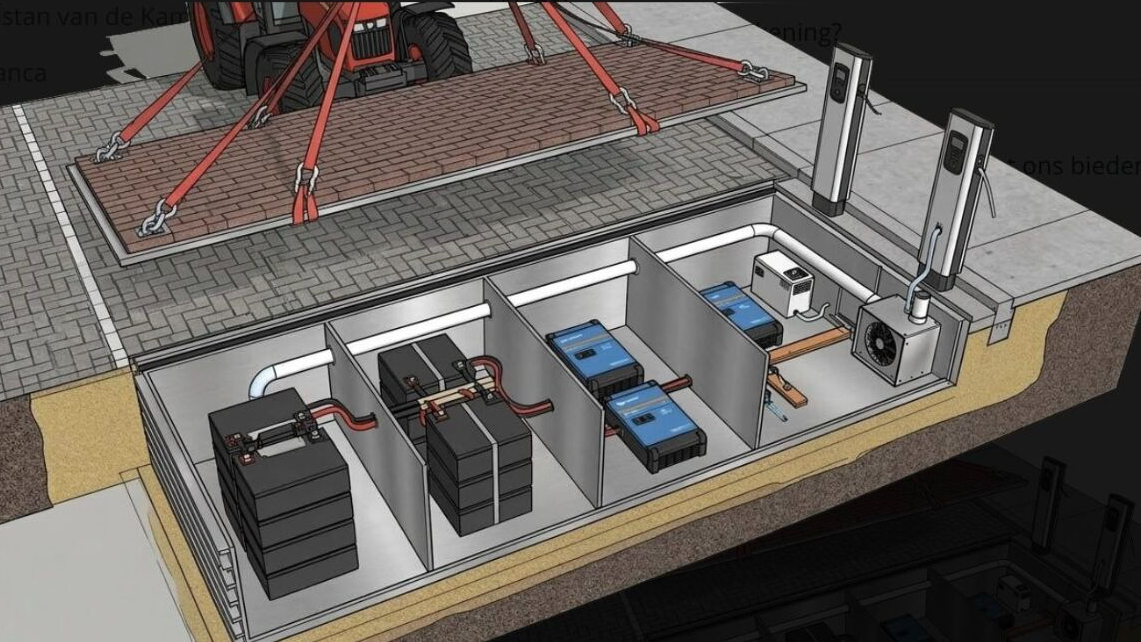
A prefab energy hub under your parking spot—one that can even be submerged in water. The charging station provides cooling. Inventor Ken van der Horst dreams of a network of small hubs that communicate with each other.
“We were overwhelmed,” he says. “In two weeks, we received 1,300 applications, and they just keep coming in. I especially didn’t expect such massive participation from private individuals.”
Strong interest from private individuals
This interest from private individuals, of course, shows just how great the concerns are about the abolition of the net metering program. The reactions, therefore, came mainly from people who had invested heavily in solar panels. “They’re mostly people with 20 or 30 panels. And they all have an EV parked out front. So the electricity in the batteries just runs out. But they’re also, above all, people who very consciously want to be in control.”
Mithra originally stated that the payback period was less than six years. “We’ve removed that from the website, although we still stand by it,” says Van der Horst.
It wasn’t just private individuals who responded. “For example, there’s also an architecture firm that was already working on connecting a collection of batteries. Then they heard about Sett and got in touch. And in Maastricht, there’s a residential neighborhood with an energy problem. They want to solve that on their own, and Sett fits in very well with that. I think that’s a wonderful, positive contribution.”
In rain and in fire
As we suspected, it is indeed a prefabricated steel enclosure. “It’s resistant to water and acid, because the soil’s acidity in the Netherlands is quite high.” It has three compartments: one for the control system, one for the batteries, and one for the inverter. There are plates on top that are sealed watertight by their own weight using gaskets.
“We’ve even taken into account the possibility that the street might flood, because that can happen with the downpours we get these days. And when that happens, the charging station acts as a sort of chimney to dissipate heat.”
If the heat does get out of hand and a fire breaks out, there’s also an aerosol fire extinguisher inside the unit that keeps the fire under control until the fire department arrives. “Then they can fill the entire unit with water so the fire is completely extinguished and no longer poses a danger. But that’s really a very rare situation. The integrated PMS monitors the unit and shuts it down immediately if it gets too hot.”
Developed for a data center
The original LinkedIn post called on people to sign up for pilot programs. But Van der Horst emphasizes that the system has long since moved beyond the pilot stage. He and his partner, Wietse Wind, have been running it for years in the data center of Wind’s company. “His company has an app with a large user base, so he also has a data center. This system was initially designed to keep that data center up and running at all times, even if the power supply were to fail. And we can now operate for at least a week without grid power, including charging five EVs.”
Hardware from China
A year ago, they realized they didn’t have to keep the system to themselves—they could also bring it to market. They then founded Mithra together. “We completely redesigned it for a home version. We’ve now engineered it in collaboration with a Chinese partner, who assembles and certifies the product. Together, we’ve come up with a first version, and five of them will be arriving in the Netherlands as early as next month.”
Van der Horst insists that the software is entirely Dutch-made. In any case, he says, they would prefer to work with Dutch manufacturers. “It’s preferable to keep such a cool invention entirely in the Netherlands. But China has such a head start in this area that it’s almost impossible to ignore.”
Opportunities everywhere
According to Van der Horst, what makes Sett truly powerful is that all the units can “chat” with each other. “Imagine an industrial park with 100 Setts—that gives you a huge combined capacity.” For now, energy still has to be transmitted via the regular grid, but at Mithra, they’re also considering their own loops in the future. “In any case, the more Setts there are in the ground, the stronger our grid becomes.”
And he also sees opportunities in the field of computing in the future. “Of course, the computing component of Sett is idle most of the time. So if you put all the Setts together in a grid, you’ll have the capacity of a large data center. We could then use that, for example, for AI computations for large organizations.”
That’s why he and Wietse always see opportunities everywhere, says Ken van der Horst. The two of them started out by installing sensors in septic tanks and sewer manholes, and then mapped out the entire chain and the logistics surrounding it. “But now the focus will likely be primarily on Sett,” he concludes.
This is an article from Construction and Installation Hub. Want to keep up with all the news from the construction and installation industry? Then take a look at the hub and sign up for the online community.
↗