Construction companies have made significant strides in digitization in recent years. Yet many processes still involve a surprising amount of manual work. Data is re-entered, information is scattered across different locations, and employees search through documents, email inboxes, and loose lists. There’s often still a lot of room for improvement here.
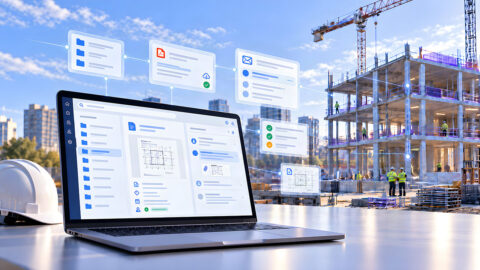
AFAS helps construction companies streamline their processes and reduce unnecessary tasks. Projects, Finance, HRM & Payroll, and workflows are all integrated into a single environment. Information is entered once and then used throughout the entire process. Additional software from partners can be easily integrated with AFAS, allowing systems to automatically share data with one another. This prevents duplicate work and facilitates further automation.
“The real gains don’t come from one big innovation, but from small, repetitive tasks that happen every day,” says Jelmer, sales manager at AFAS. “If information is already available somewhere, why would anyone need to enter it again?”
What work is actually still necessary?
Working smarter doesn’t necessarily start with new technology. First, it’s important to take a critical look at the work itself. Which tasks are truly necessary? Which steps can be simplified? And which tasks can be eliminated entirely?
An extra check, an Excel spreadsheet, or a manual transfer may have had a valid reason at one time. But does that reason still hold true today? AFAS calls this “de-stacking”: first, remove unnecessary steps from a process, and then figure out how to organize the remaining work more efficiently.
Technology can then take on more and more of that work. Workflows automatically route information through the process, employees receive tasks at the right time, and data remains available in one place. AI can also help, for example, with analyzing, summarizing, or recording information. The question remains the same: what problem are we solving with this, and what work are we automating?
“You get the most out of AI if you first identify where time is being wasted and which tasks you want to reduce,” says Jelmer. “Then you can determine much more precisely where automation or AI really adds value.”
Take a closer look at your own construction process
At DigiBouw 2026, AFAS will demonstrate how construction companies can streamline their processes and reduce unnecessary work. Stop by the booth at Jaarbeurs Utrecht, Hall 2, Booth A040, and take a closer look at your own work methods. Which tasks are truly necessary, and which do you do mainly because that’s how you’ve always done them?
At the booth, you can view examples and discuss with AFAS how your organization can streamline, automate, and better align its processes. In addition, AFAS will host a session during DigiBouw on why working with AI often doesn’t start with AI at all.
You’ll find AFAS in Hall 2, Booth A040