Grid congestion plagues new-construction homes. In this episode of Expeditie Slim Bouwen, trend watcher Marjet Rutten shines the spotlight on a solution that doesn’t start with a thicker cable, but rather behind the front door and in the neighborhood: WePositive.Energy.
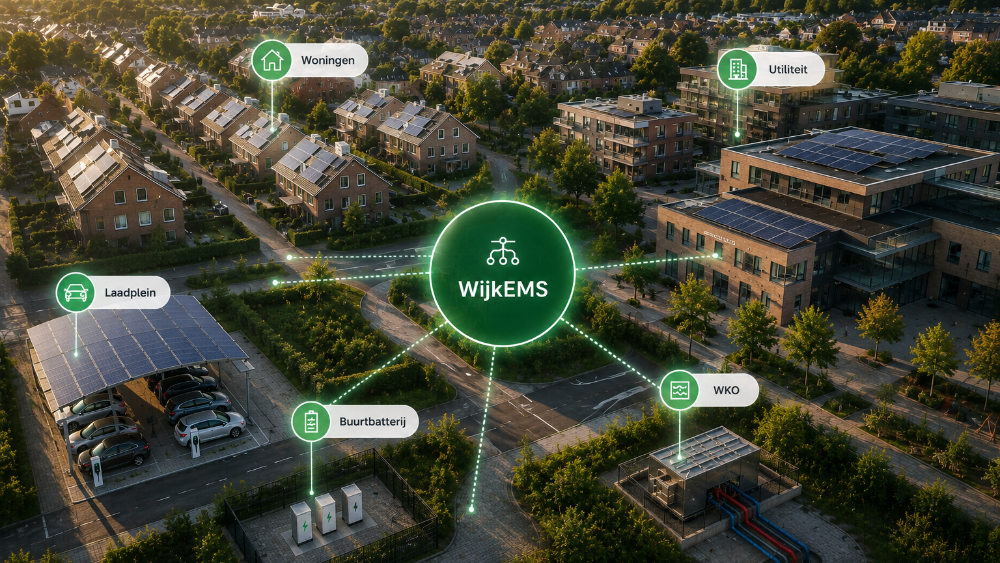
WePositive.Energy enables homes, energy storage, heating systems, and shared mobility to work together as a single local power plant. Their basic premise is simple: the problem isn’t just how much electricity we use and generate, but mainly when we do so. Solar panels all generate power at the same time. Electric cars return home around the same time. Heat pumps respond to the same weather conditions. And if batteries all respond to the same low electricity price, even “smart” energy management can cause a new peak.
WePositive.Energy therefore does not aim to make every home smarter individually, but rather enables the energy supply of an entire neighborhood to work together as a single local system. Solar panels, batteries, heat pumps, and electric cars are digitally connected to one another. Increasingly, collective infrastructure—such as district heating, energy storage, and shared mobility—is being added to this network. Self-learning algorithms coordinate supply, demand, and storage in real time.
Not: What’s most cost-effective for House A?
But: what’s the smartest choice for the entire neighborhood and the power grid?
In this way, a residential neighborhood transforms from a collection of individual energy consumers into a single, collaborative energy system.
From reduced peak demand to feeding power back at the right time
Measurements taken in residential neighborhoods where WePositive.Energy operates have now shown that this is not just a theoretical model. In summer measurements, the neighborhood’s simultaneous peak load remains below 0.5 kW per household—including electric vehicle charging and shared mobility. By way of comparison: the peak power of a single electric car alone can amount to several kilowatts.
At certain times, the neighborhood even goes a step further. Precisely when the power grid is under heavy strain, the WePositive neighborhood as a whole can feed power back into the grid. This fundamentally changes the role of a new residential development. Instead of placing an additional burden on an already overloaded power grid, the neighborhood can actively help reduce grid congestion in the region.
An interesting next step is electric shared mobility. Together with MyWheels, WePositive.Energy is integrating Vehicle-to-Grid shared mobility into the energy system. As a result, electric shared cars can not only be charged intelligently, but can also feed electricity back from their batteries during peak times. This is already happening in practice in the Mandora Eco-Neighborhood in Houten.
The WePositive.Energy Survival Kit
- Collective AI control—homes, solar panels, batteries, heat pumps, and collective energy systems are coordinated in real time.
- Less than 0.5 kW peak load per household—in summer measurements, the peak load remains below this limit, including electric vehicle charging and shared mobility.
- The neighborhood helps the grid—during times of high grid demand, a WePositive neighborhood as a whole can even feed electricity back into the grid.
- Shared cars become neighborhood batteries—through Vehicle-to-Grid technology, electric shared cars can not only charge but also feed power back into the grid at strategic moments.
- Energy remains local as much as possible—locally generated electricity is used directly in the neighborhood whenever possible or temporarily stored.
- More than just individual homes—collective heating, energy storage, and shared mobility are also becoming part of the joint energy management system.
- New construction and existing buildings—the approach isn’t limited to a single type of home or to newly developed neighborhoods alone.
Survival tip: Don’t optimize your home—optimize your neighborhood
A system that responds individually and intelligently to the same electricity price as thousands of other systems can, collectively, turn out to be quite ineffective. The lesson from WePositive.Energy: when it comes to energy optimization, don’t just look behind your own front door. It is precisely by jointly managing homes, heating, storage, and mobility that we create capacity on an electric grid that needs it more and more urgently.
This also reveals something important: residents do not have to be an obstacle to these kinds of systems. WePositive.Energy’s experience is, in fact, that residents embrace the approach and are willing to make their flexibility available. However, according to the company, for large-scale implementation, there needs to be something in return: appropriate financial incentives for residents who use their homes, batteries, or cars to help relieve the strain on the power grid.
Perhaps this also means our definition of a smart home needs to be updated. Soon, the smartest home won’t be the one that optimizes everything on its own, but the one that, together with the rest of the neighborhood, knows when to charge, store—or, conversely, feed power back into the grid.
About expedition Slim Bouwen

Construction is like surviving in a jungle of rules, ambitions, and problems. In “Expedition Smart Building,” Marjet Rutten takes you every week to a groundbreaking site or location where they’ve overcome all the obstacles and hurdles along the way. If you also have a special place you’d like to highlight, please email the editorial team.
Rutten has been working in the industry since 1998 and wants to contribute to a dynamic, successful construction sector. In addition to her work for Building Balance, she is active as a Gideon and serves on numerous government review committees and juries, where her responsibilities include assessing the market potential of planned product and process innovations. You can order her latest book, *From Brick to Blockchain*, about developments in the sector leading up to 2040, here. Looking for more inspiration on developments in our sector? Visit www.debouwin2040.nl
See also: Frisian builder solves grid congestion with heat pumps and car-sharing

This is an article from Construction and Installation Hub. Want to keep up with all the news from the construction and installation industry? Then take a look at the hub and sign up for the online community.
↗