“A lot of time is wasted because we make many agreements, but we don’t always make it clear enough how we’ll demonstrate that we’re on track,” says Pim van Meer in this issue of Digitale Doolhof. That’s why it’s time to take a close look at the prior agreement.
The preliminary agreement is perhaps the most underrated document in area development when it comes to digitization.
That sounds strange, because no one refers to this document as “digital.” It’s legal. Administrative. Financial. Sometimes tedious. Often sensitive. And usually only becomes truly popular when everyone starts to get nervous.
But that’s exactly why it’s interesting! Because the preliminary agreement brings together almost everything that makes area development so complex. Program. Cost structure. Public space. Parking. Sustainability. Energy. Climate adaptation. Permits. Planning. Risks. Public participation. Ownership. Phasing. Decision-making.
In short: the whole rigmarole, but with signatures at the bottom.
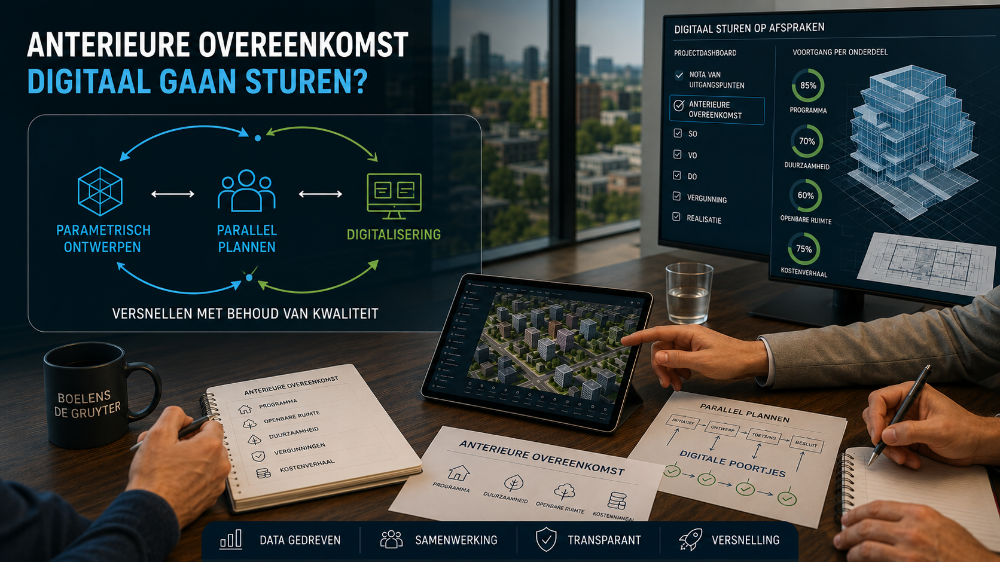
Tim Diepeveen of Boelens de Gruyter therefore presented a good—albeit uncomfortable—idea to NEPROM’s digitization committee. Could we structure the recurring elements of preliminary agreements using a standard template with standard options?
Not to override local agreements.
Not to prove a legal point.
Not to take away municipalities’ policy autonomy.
Not to create yet another model agreement that everyone admires but no one uses.
But to ask a much more interesting question: which elements recur consistently, and which of those can we translate into measurable goals?
That question hits the nail on the head. After all, many of the provisions in preliminary agreements are not unique in substance at all. Of course, every city is different. Of course, the political context varies. Of course, the location, ownership, program, and land use are never the same. And of course, every municipality must retain the flexibility to pursue its own policies, priorities, and administrative decisions.
But beneath that project-specific layer, there are a striking number of repetitive questions.
How many homes will be built?
Which market segments?
What parking solution will be implemented?
What will the quality of the public space be?
What are the sustainability goals?
What studies are needed?
What is a realistic timeline?
When can an application be submitted?
When is a design good enough?
When will there be enough administrative confidence to move forward?
Those aren’t questions about attachments. They’re guiding questions.
And those questions are still too often insufficiently linked to verifiable information. We agree on a lot, but we don’t always make it clear enough how we’ll demonstrate that we’re on track. This leads to discussions about interpretation later on. The developer thought something was sufficient. The municipality disagreed. The consultant had misunderstood the assignment. And in the meantime, the planning department had long since acted as if the decision had already been made.
That wastes time.
Not because people don’t want to, but because agreements, information, and decision-making still too often exist in isolation from one another.
That’s exactly where the opportunity lies.
If we want to take digital parallel planning and parametric design seriously, we can’t just focus on models and standards. We must also revisit the contracts that define the process. The preliminary agreement is crucial in this regard. It is not just a legal document. It is also a process document. A risk document. An information document. A document of trust.
And that includes a digitization document as well. This is where supply chain integration—and, of course, our MiniBIM and MiniGIM—come into play.
MiniBIM helps make building information available for discussion earlier and in a more consistent manner. MiniGIM helps organize site information more effectively. The preliminary agreement falls right between those two worlds.
It affects both the building and the surrounding area.
The business case and the public preconditions.
The developer and the municipality.
The executive and the consultant.
If we can link recurring sections of the preliminary agreement to minimum information requirements, it will create a better review schedule. Then you don’t have to finalize everything too early. That would be unwise. But you can agree, on a phase-by-phase basis, what information is needed to proceed responsibly.
What do you need to know about the statement of principles?
What must be verifiable in the prior agreement?
Which components belong in SO, VO, or DO?
What information is needed for a digital portal?
And which provision is still an aspiration but not yet a demonstrable guiding principle?
That distinction is worth its weight in gold.
Because parallel planning doesn’t mean we just throw everything into the blender at once and hope a permit comes out at the end. Planning in parallel means you know sooner which dependencies are critical. You see sooner where information is missing. You discuss sooner where the risks lie. And you decide sooner whether a plan is mature enough for the next step.
For that to happen, contracts need to be more compatible with this process.
Attention, executives: this is how digitization will help you with contracts—not by replacing lawyers, but by better linking the agreements you rely on to information, evidence, and decision-making.
This helps municipalities because they receive clearer answers regarding their public requirements. It helps developers, because risks become apparent sooner and the process becomes more predictable. It helps consultants, because their mandate becomes clearer. And it helps administrators, because they have to rely less on gut feelings and more on shared decision-making information.
That’s supply chain integration. Not just a buzzword, but a practical working principle: making agreements in such a way that the next party in the chain can work with them.
That’s why I’m grateful to Tim. To me, he’s a champion of the kind of digitization the industry needs—not the digitization of a flashy demo, nor that of a one-off experiment. But the kind of digitization that dares to lay bare a difficult contract and asks: what aspects of this can we make repeatable, scalable, and verifiable?
That’s exciting. (And it’s too much responsibility for Tim, so if you’re a developer, join us at NEPROM. Send an email to digitalisering@neprom.nl. )
Because as soon as you make agreements verifiable, it also becomes clear where they are vague. As soon as you link information to decision-making, it becomes clear where decision-making is actually driven by assumptions. And as soon as you link contracts to digital gateways, transparency suddenly becomes very concrete.
Great. Because that’s where mature collaboration begins.
The standard template with standard options doesn’t have to become a digital straitjacket. On the contrary, it can actually help clarify local decisions. What is generic? What is project-specific? What is municipal policy? What is negotiable? What is verifiable? And what still requires administrative discussion?
If that works, the preliminary agreement will shift from being a contractual formality to a management tool.
And then acceleration doesn’t start at the end, by pushing harder. Instead, acceleration starts at the beginning, with better agreements.
I’m sure Friso de Zeeuw is proud of us.

This is an article from Construction and Installation Hub. Want to keep up with all the news from the construction and installation industry? Then take a look at the hub and sign up for the online community.
↗