UrbanAIR is a digital twin of the city, but that’s only a small part of the story. Above all, it’s a tool designed to enable better decision-making in the city—so that a healthier city can emerge. “Because ultimately, it’s all about people,” says project coordinator Femke Vossepoel.
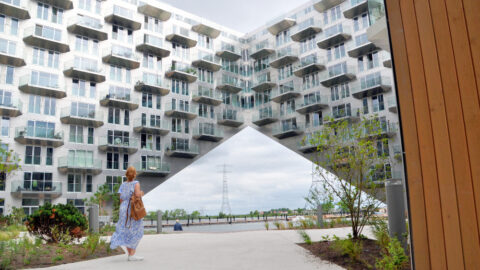
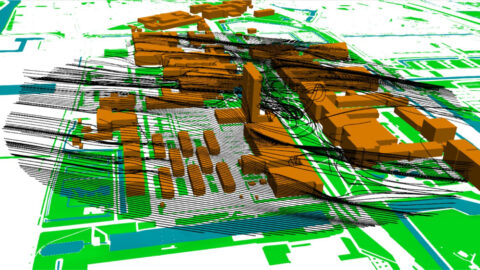
Her office is right next to a TU Delft building that was constructed at just the wrong angle. “When the wind blows at a certain speed, cyclists get blown over, and my office gets extremely hot in the summer. That could have been prevented if the developer had known that in advance.” That, in a nutshell, illustrates what UrbanAIR can do for a city. It can be used to simulate various climate scenarios at the street level, allowing you to see, for example, how much wind blows past a tall building or how much heat stress builds up in certain areas of the city.
What-if
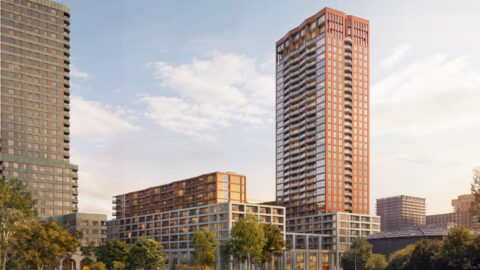
“Imagine if we built a massive skyscraper right across from here—how would that affect, for example, air quality and heat in the city?” We’re sitting on a patio in Utrecht, and in just a few words, a gigantic building has appeared between Tivoli-Vredenburg and Hoog Catharijne, right on top of the Singel, which has just been re-dug.
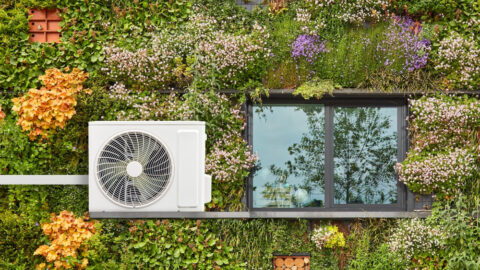
“And what if I paint that tower completely white?” Vossepoel continues. “Or what if I give it green walls? That would change the thermal stabilization. There are so many different factors. How does the air behave, and how do the various substances in the air behave?”
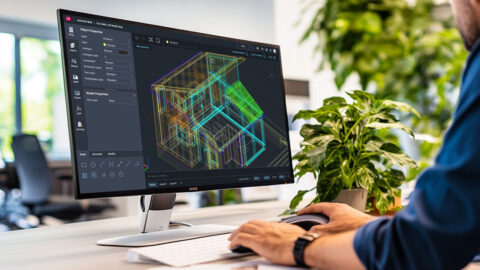
Calculating and visualizing what happens in such a “what-if scenario” is exactly what TU Delft’s UrbanAIR project does. Prof. Dr. Ir. Vossepoel is the project leader. “It’s a digital twin of the city, but it’s more than that. It includes all kinds of models of air currents, wind, and weather, as well as how people behave in a city. How do they move around the buildings? Do they go to the park on hot days?”
Barcelona and Antwerp
The model is already being used in a number of cities. For example, Antwerp wanted to map out its green space potential—where to plant trees to keep the city cool while also improving air quality. “You shouldn’t do that haphazardly under the motto ‘the more trees, the better, ’”Vossepoel points out. “Because trees also block the wind and thus hinder airflow. In Antwerp, they wanted to know where it would be best to add green spaces.”
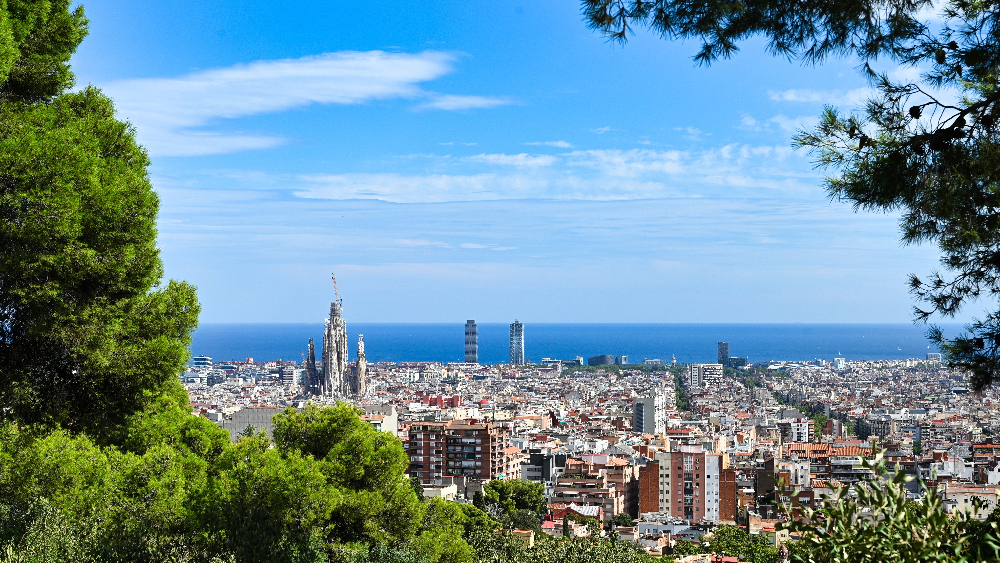
Barcelona is the second city to use UrbanAIR’s digital twin. “They wanted to know how polluted air lingers and, consequently, when they exceed a certain level of air pollution. And they wanted to know what happens during extreme events, such as heat waves. How does a city deal with that?”
UrbanAIR is active in three other cities as well—the so-called “learning cities”: Rotterdam, Bristol, and Paris. “We’re currently creating digital twins specifically for these cities, but the tools are universal. So any city can use them.”
Incredibly complicated
UrbanAIR applies all kinds of models to those cities so that various scenarios can be simulated based on data. “We want to determine as accurately as possible what matters, what has an impact in the city.” And that’s quite complicated, says Vossepoel. “Because air movement isn’t linear, and turbulence is incredibly complex. So you need a very fine-mesh grid, and clever techniques to calculate and parameterize very small processes.”
Vossepoel has spent virtually her entire professional career working on such complex models and how to improve them using observations. She once earned her Ph.D. on improving models for El Niño. The methods she used in that research were also applied in the oil and gas industry, and she subsequently put them to use at Shell. She then moved to Delft University of Technology to map land subsidence caused by gas extraction and geothermal energy. “What can you do in the ground while still staying safe?” is how she summarizes that research.
Healthier City
And now she is the project leader of UrbanAIR. Vossepoel is clear about its goal. “The ultimate goal is for better decisions to be made in the city, because decision-makers can analyze multiple scenarios. And thus, we’ll end up with healthier cities.”
And that’s becoming even more important due to upcoming legislation from the European Union. For example, the Clean Air Directive will take effect in 2030. “By then, all cities will have to report on their air quality. And we can help municipalities assess how certain decisions affect that air quality.”
But it’s not as if every city can implement a ready-made system right now. “We’re developing a prototype. Everything is open source, and it would be great if a startup were to bring this to market. But as a municipality, you can also do it yourself. You’ll need a few good experts, though.”
Listening Better
UrbanAIR primarily generates a lot of calculations and therefore focuses mainly on probability analysis across various scenarios, Vossepoel reminds himself in closing. “The mistake that’s often made is that scientists tend to look at things far too much from a scientific perspective—that is, through numbers and calculations. But ultimately, it’s about people.”
“Our model doesn’t provide absolute truth, but based on what we see, we can work with municipalities to determine what people need. What we do is very technical, but our main goal is to make a social impact. That’s why we need to learn to listen better.”

This is an article from Construction and Installation Hub. Want to keep up with all the news from the construction and installation industry? Then take a look at the hub and sign up for the online community.
↗