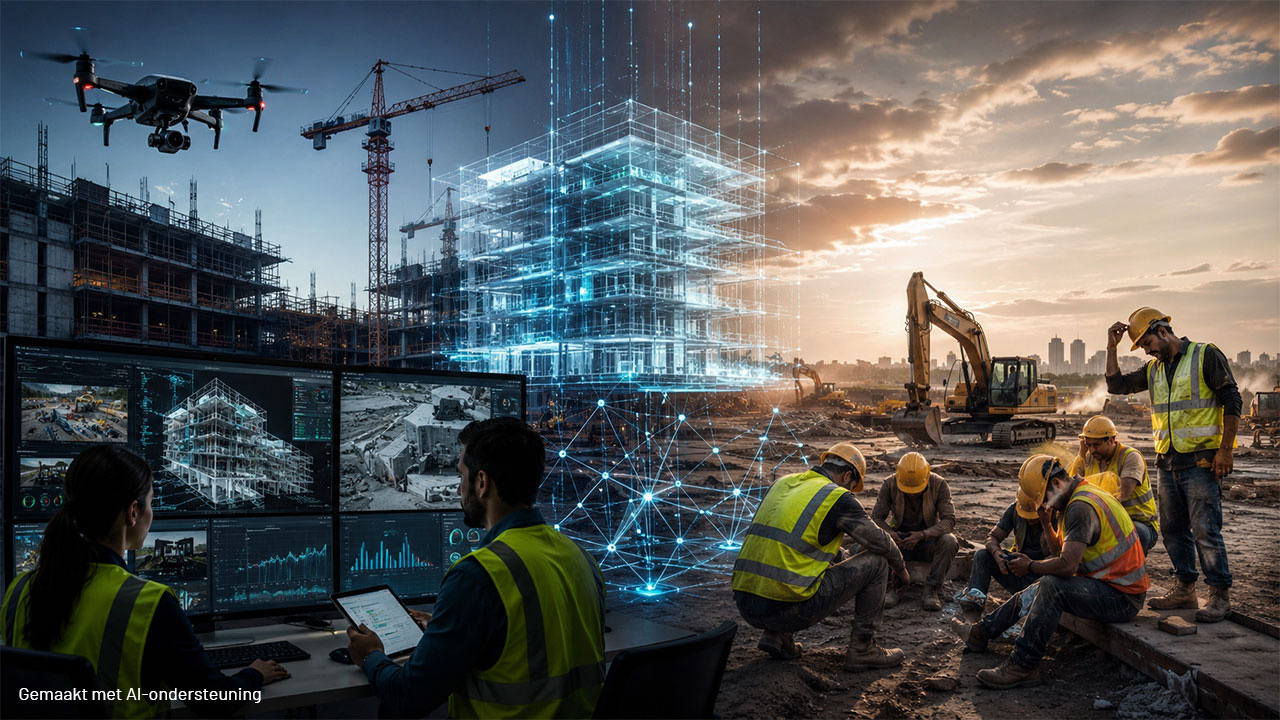

If you walk through a modern construction site, you’ll still see concrete mixers, excavators, scaffolding, and construction workers. That makes sense—after all, you can’t stick bricks together with 1s and 0s. You need cement for that. But amid all that traditional equipment, a second, less visible world is emerging: the world of data.
Excavators can be controlled digitally, drones and 360-degree cameras capture the current situation, sensors measure conditions, and software links information from the construction process to BIM models. The European Commission now considers BIM, drones, 3D scanning, sensors, and the Internet of Things to be among the most important technologies for the digitization of construction companies.
Every action is a data point
As a result, the construction site is beginning to take on the characteristics of a data center. Not because there will soon be rows of servers next to the site office, but because virtually every action can become a data point in an impressive and complex data model.
Take reality capture, for example—the live recording of activities on the construction site. Drones, laser scanners, and 360-degree cameras can periodically capture digital images of a construction site. Research at the University of Twente is now taking this a step further by linking BIM to autonomous flight planning for drones that conduct construction inspections. Meanwhile, commercial systems compare images with BIM models and schedules. This allows software to flag when a component is missing or when construction is behind schedule.
AI is also making its way into the construction site. Systems like Construction IQ analyze project data using machine learning and attempt to prioritize risks and issues. At the same time, Autodesk, the provider of Construction IQ, warns that the system does not identify every risk and may also incorrectly flag some issues as risky; it recommends using it as an assistant alongside existing safety processes and human practical experience.
The line between “connected” and “truly intelligent.”
After all, a construction site that knows a lot is not yet a construction site that can make decisions on its own. TNO makes that distinction clear when discussing predictive twins: when a digital replica is connected to the physical structure via sensors, it can use that measurement data to assess behavior, learn from it, and make predictions. Those predictions then support people in their decision-making.
The reality, however, is less digital than the vision of the future suggests. A 2021 European survey shows that sensor technology is relatively mature and that 3D scanning and drones are gaining ground, but that the Internet of Things (IoT) is not yet widely adopted. BIM is being used more frequently, but often gets stuck in the design phase. At the end of 2025, the European Commission noted that the digitization of the construction industry in Europe is still proceeding unevenly. According to the Commission, the integration and exchange of data between digital systems are also lacking. This means that the self-learning construction site is not science fiction, but it is not yet everyday practice either.
For now, then, the real revolution isn’t a construction site that replaces the foreman. It’s a construction site that’s getting better and better at observing, measuring, comparing, and predicting. BIM specifies what needs to be built, cameras and drones record what’s actually there, machines and sensors provide real-time data, and AI looks for discrepancies.
Only when those data sources are reliably connected to one another will the next step emerge: a construction site that not only reports what is happening, but also recommends what should be done and predicts what will happen if the recommendations are followed. Because that’s still what they are: “recommendations.” For the time being, a team of people will remain ultimately responsible.
So the construction site won’t literally become a data center. But data is increasingly becoming its digital nervous system. The question is no longer whether the construction site will become connected. The interesting question is when we’ll trust it enough to let it help make decisions.
What might the future hold?
What if the influx of thousands of data signals from all those different sources—such as BIM, machines, cameras, drones, and logistics systems—were technically integrated, and AI models drew conclusions based on them and processed them through algorithms? Will the construction site then become smarter than the specialists who designed it? Will they still be able to understand it all and intervene if the algorithms make a mistake? There is still a long way to go.
November 25 & 26, 2026 | Hall 2 | Jaarbeurs Utrecht
The Construction Site and the Future
What will digital construction look like in 2026? Who are the thought leaders? And who are the visionaries who are guiding us toward the future?
The DigiBouw 2026 program takes you on a journey through everything digital construction has to offer across 6 theaters and 1 main stage. Dozens of knowledge sessions will bring you up to speed over two inspiring days.